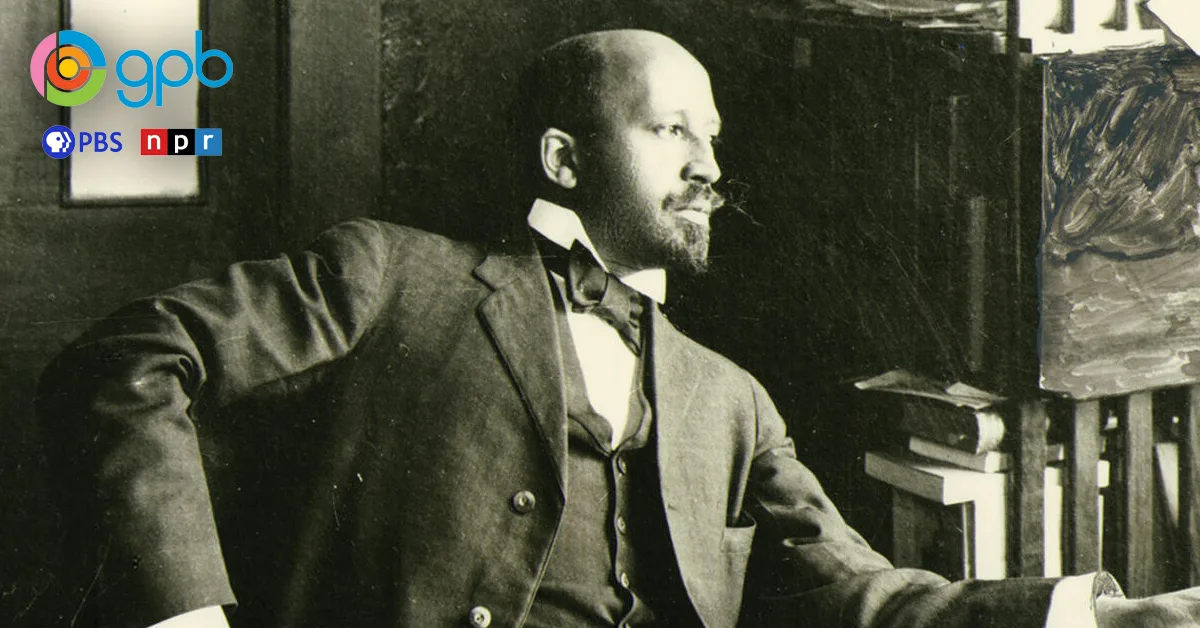
W.E.B. Du Bois: Rebel with a Cause airs May 19 on GPB as part of the PBS American Masters series. Documentary director Rita Coburn spoke with GPB’s Kristi York Wooten about the writer and activist’s impact and stints he spent in Atlanta.
Kristi York Wooten: Today, we’re talking with Rita Coburn. She’s the director of a brand new documentary about W.E.B. Du Bois, Rebel with a Cause. It airs GPB on May 19 as part of the PBS American Masters series. We’re happy to have Rita here. We’ll get started and jump right in with some questions for you, Rita. I know that in the past, you’ve done award-winning work. You did a 2016 project about Maya Angelou, And Still I Rise. You also did a portrait of Marian Anderson, The Whole World in Her Hands in 2022. And here we are now with the W.E.B. Du Bois project. Take me on your personal journey to learning about the work of Dr. Du Bois and how you got interested in his work.
Rita Coburn: Well, unlike a lot of people in this country — and then also similar to that — I did not have any African-American history courses. If they were offered in the schools that I went to, I was not engaged or aware of that. And so, I’m probably self-taught when it comes to history. I’ve always been interested in the history of Black people. It was something that I wanted to know about, when I saw books when I was growing up and we were missing in those books. And I knew that my aunts and my family were really important to me and I didn’t see them portrayed. So, it was always my prayer and my mission to find out more about us. For W.E.B. Du Bois, I was not really very aware of him at all. And I happened to be working for Oprah Radio, and I would stay with Maya Angelou four days a month to get shows for the Oprah Radio broadcast that we had. And I knew a little bit about him, but when I talked to Maya Angelou about him, she could tell that I didn’t know enough, and I saw the pretty much sorrow on her face at that. She was really unhappy, and I thought, “I need to learn more about this man.” So, I started doing a little reading. And when I saw on the WNET website that W.E.B. Du Bois was a documentary that Michael Kantor wanted to do, but that it had no director, I knew that that was my opportunity — to not only do the documentary, but to learn more about him. By that time, Maya Angelou had passed, and she had had some time with him in Ghana. So that started my journey.
Kristi York Wooten: One of the things that strikes me about this documentary is the chronology is so complete. It takes you from his earliest days, from the late 1800s to the eve of the March on Washington. So it’s very comprehensive in that way. When you were learning about this in-depth material, was there a single jarring moment that you think defined Du Bois’s life or that propelled him into kind of the stardom he achieved with all his writings?
Rita Coburn: I think there was a moment. First, I knew about 16 books; I would come to know about 21. And I was trying to read and listen to as many of them as I could. When I started talking to the scholars, they said, “Good luck; we haven’t gone through all of them.” It’s really a daunting task. So, I had interns take a few books. I took a few books and I started reading. One of the things that really allowed me to understand that he — There were actually two things, Kristi. The first was, he decided, this quote, “I decided early on I was going to prove to the world that Negroes were just like other people.” I think that started him on his journey. But I think his pivotal moment was when he was, in 1899, in Atlanta, and his son died because there was no help for his son, because he was a Black child that white doctors didn’t want to touch. The Black doctors weren’t around. When that happened, all of the science and all of the intellect — he was shaken, and that happened. And then that same year, Sam Hose was lynched and people — I’ve run into people said, “Didn’t he know that Black people were getting lynched?” We’ve become so casual about that. He was having an experience at that moment and coming from Great Barrington [Massachusetts], where there had been integration and agency and education for him for years. Atlanta was the pivotal moment. And so in 1899, when his son died, when Sam Hose was lynched and parts of his body [sold] in a meat market, that was it for him. He decided he had to be very active as a person who — he called it “propaganda.” We have a negative connotation to propaganda now, but what his word meant was, “I have to fight with my pen and everything else that I have. I can’t just go by reason. I can’t just go by the science of the proof.”
Kristi York-Wooten: There’s a lot you just said I want to touch upon. First of all, the propaganda element. I noticed that in the documentary as well. The definition is more about “propagation” than it is about propaganda as the word we know because he became devoted in writing about the African-American experience and wanting to tout that solely to everyone so that sociological aspects of covering that would help further the causes that he wanted to see happen in his lifetime. So let’s talk about Atlanta, too. Atlanta does play a pivotal role at a few different points in his life. And you mentioned that early time in Atlanta when he and his wife and infant son had traveled and he was working at the — Atlanta University is what it was called at the time. But, when he came to Atlanta — and throughout his life, every time he returned to Atlanta — it was the promise there. Today, we see or we view Atlanta as being a center for Black excellence and a partial fulfillment of this promise that W.E.B. Du Bois wanted to further. But he also felt the intractable racism and things like that that he kept bumping up against, which kind of prevented him from spending more time in Atlanta. Do you agree with that?
Rita Coburn: I do. Because I think that we have pockets in the world, even in our communities, where growth is possible. If it’s your church and the surrounding community is not as welcoming, you have a pocket. But that doesn’t mean that all these other things don’t exist at the same time. So being in the Jim Crow South, being across that Mason-Dixon line, being in a place that was fertile ground for Black intellect —I’m in Atlanta now. My mother was born in Washington, Ga. Georgia was a hub in the whole country and Atlanta was that for Black people. So while he could get the camaraderie, while he had colleagues, while he could get respect from both Blacks and whites in Atlanta, in this pocket, it was all surrounded by the fact that there was a hold-me-down mentality to the people there with money and power, and the Jim Crow South was the Jim Crow South. But he could return to Atlanta to write Black Reconstruction. He could return to Atlanta because Atlanta was where he found home, in a way.
Kristi York Wooten: There are several things in the documentary that have parallels to today. And one of the ones that I found fascinating as I was watching is that Du Bois started his academic career more from a science perspective. He was very interested in data. In some ways, this film paints him as kind of an early godfather of the infographic, you know? He was coming up with visual presentations to get the data and demographic information that he was studying from a sociological standpoint, to get that across. So that was fascinating. But then that sort of science side also becomes married to his love for the arts, which he discovered when he was studying and living in, or studying in Europe and going there for the Pan-African Congresses and things that he did over the years. So he was very much a part of that 20th century marriage of arts and sciences. You know, the newspapers a hundred years ago had arts and sciences on the same page. Now, of course, everything’s tech and arts and it’s all separated, but he was part of that kind of coming together of that intellectual development that happened in the 20th century, which led to him and others wanting to make sure that people were educated. Can you talk about his desire to achieve the highest height of what he considered the pillars of education, getting a Ph.D. ultimately from Harvard in the end? Talk about how that the arts and sciences is kind of married to this idea of furthering education, which today we see kind of a degradation of that, in some ways.
Rita Coburn: I think that’s exactly correct. I think coming from Great Barrington — we couldn’t put everything in [the documentary], but he was over the sewing circle at his church. He was — began to come to what we call now the polymath, very early on. He tutored other young people in the school. His — Reading was very important to him. I think his first understanding of the arts through music came when he was at Fisk, and he heard the Fisk Jubilee Singers. And I think that that opened his mind to: Singing doesn’t have to be staid. This — this guttural pain that is classically arranged is calling me, and he had an experience with that. And then, as you mentioned, in Berlin, he’s going to travel widely at that time. So he’s gonna go to Paris, he gonna look at Russia, he’s going to go to London, he’s going to begin to see the great works. And I’m sure he then became involved with classical music. So his — his foray into the arts made him fearless. Any time you decide to take on The Star of Ethiopia and cast over a thousand people in a play — on steroids, as one of our scholars would call it — and you want the art of that time period portrayed, the music of that time period, the clothing of that period. His unilateral global understanding of the world at such an early age opened up his intellect. And I believe the other person that did that, that we couldn’t put in here so much was his schoolmaster in Great Barrington was pouring into him. And this man [DuBois’ high school teacher, Frank Hosmer], wanted to see how far could a Black mind go if I just fed everything I took, Latin, art, and so on. And the world was able to answer that question. He was just a very capable genius of his time.
Kristi York Wooten: He lived almost a century, so his life did have parallels to all these different movements. One of the things that the documentary does a great job is, I didn’t know so much about the publication, The Crisis, which is a huge part of his career and his involvement with the NAACP. And The Crisis magazine being such a huge part of Black American life and people looking to that, there’s a part in the documentary that says that you could find two publications on people’s nightstands or tables and that was the Bible and The Crisis. Can you talk a little bit about how The Crisis is such a big thread through the documentary?
Rita Coburn: Yes, and I believe he died at 95. So he lived longer than most people, because born in 1868 and then the March on Washington, when he died, was 1963. The Crisis Magazine was born out of the fact that after the Springfield riots and the Niagara movement had ended, where Blacks tried to form better ability to have rights in the country. There were a lot of white, well-educated, liberal people that said, “We have to do something.” If — if lynching and mobbing has jumped the Mason Dixon line. It’s not just the South, it’s happening in Springfield. So they helped start the NAACP, lawyers and people with money, with an abolitionist spirit. They start the NAACP and he is the only Black person on the board and he becomes over The Crisis magazine. And by now, He’s actually started and failed at several magazines that we didn’t have time to talk. So, and he started out writing in Great Barrington for even New York papers. So he’s got the chops for this. And he now says, “I am going to” 1910, this is the internet for what we have now. This is way that people can communicate. There was a high price put on writing. But then think about it, a lot of Black people were just learning to read. They were still learning to read. So The Crisis magazine helped them to learn to read and it helped them to understand that there was more than their communities. It became something that went around the country. And they started hearing about Haiti. They started hearing about African countries. They also started hearing about “Teach your children to brush their teeth.” There was everything that you might want. It was like a mall, a shopping mall. There was every thing that you could want for the mind in The Crisis magazine. And then we know in our culture, as we’ve had, there was a time when we had Ebony and Jet were only some of the few, but once that breaks open and you start to get more magazines and more opportunities. And in his case, with the Great Depression, it started to shrink. But The Crisis was a place for arts, a place where music, a place for international politics. And that was — it fed the hunger of a group of people that only knew what was on their block.
Kristi York Wooten: . There’s just so many fascinating things about this documentary, but another thread is his sort of beef with Booker T. Washington over different ideas. Of course, Tuskegee Institute and Booker T. Washinton believing in, or the film presents it as he believes in, Black people needing to be part of the workforce to prove themselves whereas Du Bois was coming at it from a more almost elite perspective of the education leads to leadership, leads to positions of power. So they had different ideas there, and that was fascinating. Can you talk a little bit about their clashes?
Rita Coburn: I think that both Booker T. Washington and W.E.B. Du Bois were coming to one point from different aspects. Booker T. Washington had actually been enslaved until he was about 6 years old. He had a very different view of the world than someone who grew up in Massachusetts listening to classical music and being educated from the beginning. And then at first, Du Bois agreed with a lot of what Booker T. Washington was saying. But one thing you will find in this documentary is that Du Bois has the courage to change his mind. He has the encourage to think more broadly and he takes no prisoners. If it’s a president or a Black leader and he doesn’t agree, he — That’s why I call him a rebel. He goes against that grain. And so I think that Booker T., from his background had began to make partnerships with people with money and power. And underneath all this — we would have to do a lot more reading and digging — but those people needed a workforce because the slave labor was gone, but these companies needed a work force. So he was populating that workforce, whether he was manipulated by that or not. People had different energies they wanted to bring to that. Du Bois was looking at a broader view. And he said, you’ve got to be able to vote. You’ve got be able learn about law and you have to be to read a book. There was a line that I wasn’t able to use, but he said if Booker T. had seen a young Black boy looking at a book trying to learn French in his yard, it would be, “Why would he do that?” So that what Du Bois wanted was an expansion of the mind. And I will say that in his later years, someone took a swipe at Booker T. by the time he was in Ghana, and his response was “Leave him alone. He was trying to do the best he could.” So as he got older, it’s like the upstarts that come in every generation. He knew that he was coming and Booker T. was descending. And I think that was necessary in our history. And — But as Du Bois got older and understood how hard life really, really was, he kind of looked at Booker T. Washington as someone who was doing the best he could with what he had.
Kristi York Wooten: You talked about, of course, the title being Rebel with a Cause. And there were some interesting sort of rebellious things — rebellious thinking that Du Bois did. And one was to initially support President Wilson. And then after that, what happened? People have to watch the documentary, of course it’s history, but the idea that he wasn’t scared to support him. And then he also wasn’t scare to come out and say later, this was wrong. He also, y’know, followed different trains of thought. And in the end, when he died in Ghana, a lot of people had been calling him communist for a couple of decades, because he was part of a peace movement, anti-nuclear proliferation, things like that. So he was alive and well during all the McCarthy-era things that were happening and you demonstrate this in the film and I don’t think a lot of people they might know about his big historical achievements but maybe not know about these last sort of 15 years of his life or the very beginning parts of his life. So can you tell us a little bit about this this last era that is portrayed in the film?
Rita Coburn: Well, I think that the challenge always for a documentarian is to get their audience to come back to a time period. And in that time period, just like the word “propaganda” was different than the way we see it today, “communism” and “socialism” were different. When I hear people say, “He was a communist,” you have to put it in the context of he understood that capitalism was not working worldwide. And some people would say it’s not working now. It’s working for people who have, but it’s working to have nots. One of the things that I came to know about Du Bois was at first he was after Black and African American equality. Then he saw caste and he saw this as a Black, brown and even any disenfranchised whites as needing to have more agency in this society. So he first began to think that socialism would be a better way to bring people together, to make sure people had work, to make sure that the arts and medical — that there was medical attention to everybody who needed it regardless of the amount of money they have. I think a lot of us agree with that today. However, at that time, if you ran up against the powers that be, there was a cost to it. And so I believe he was called a communist before, when he was really looking at socialism. And then he looked at how communism was working in some places and not in others. But I think the main point is during that time period, we had not settled on how the world was going to work. We think that in 2026, but if you look at the ’20s and ’30s, we were clamoring with ideas and the ideologies pulling from communism, pulling from socialism, pulling from capitalism to try to figure out how we could have a better society.
Kristi York Wooten: What do you hope viewers will take away from this documentary? A lot of them may not even know about Du Bois, especially younger people. Others may have studied, but maybe from only one perspective. So what do you hope people get out of it?
Rita Coburn: It’s a wonderful opportunity to go back in time and look at someone who lives long enough to touch a recent time that we can all hold on to. The March on Washington is the gift that just keeps on giving. What we really want in my bones as a documentarian, I understand that people watch documentaries because they want to learn something. We start at a point of failure. He lived 95 years. I have an hour and 52 minutes. I would say: Look at what is happening in this society today. Look at the similarities and read. And look at some of the ways in which his thoughts, where if we bring everybody that’s disenfranchised together, that group has enough power to become stronger. Not to disregard people that have money, that want to give money, that want to use money and be fair to people, but that we have to have a better union. And I see that now with the protests that are happening around the country. The protests are largely white. I’ve heard some white people say, even in the media, you guys stay at home, we’ve got this. If you come out, we’re concerned about how this might promote more violence. But one of the things that we’re seeing is protesting, voting, all of the tenets of what — and building relationships across racial and ethnic lines. — when you look at the end of the documentary, you see him in China, you see him all around the world saying, “We can come together as people.” And when we start the documentary he says, “I believe that all men are brothers.” And in the end, I personally believe that that’s what will save us is when we get to that understanding. We’re just taking a darn long time getting to that understanding. It’s, you know, you want to make sure that the person who works in a job that is blue collar, that is white collar, that everybody has enough to feed their children, to aspire to do better and to do more for others. And that’s the brotherhood of humanity that I hope people see in the film.
Kristi York Wooten: Rita Coburn, director of W.E.B. Du Bois: Rebel with a Cause, which premieres on American Masters on PBS and GPB on May 19. Thank you so much for joining us, Rita.
Rita Coburn: Thank you, Kristi, it’s been a real pleasure. Thank you so much.